
Before You Buy More Leads, Fix This First
Most growth problems are visibility problems dressed up as demand problems. The difference costs you a year of misdirected spend before you figure it out.
You're closing 90% of your demos. Your growth feels harder than that number says it should. Something doesn't add up and you've been assuming it's a demand problem.
It isn't.
Most pipeline problems look like growth problems from the surface. The real constraint is almost always underwater.
When I sat down with the leadership team of a construction SaaS company earlier this year, the numbers looked strong on the surface: 90% demo-to-close rate, 240 customers, consistent year-over-year revenue growth. But when I pulled the actual pipeline data, 38% of their annual revenue was completely invisible. No source, no attribution, no way to invest to grow it. Their CRM wasn't just incomplete. It was actively misleading the decisions being made around it.
The constraint wasn't demand. It was visibility. And every dollar they were about to spend on marketing would have made the problem worse, not better.
On Paper, Everything Was Working
On paper, this was a high-performing business. The company ran roughly 23 demos per month and closed 90% of them. It was generating 407 projects per year in revenue. The founder knew his market cold, the construction tech space, and every customer who got to a demo was essentially a closed deal.
From the outside, you saw a tight sales engine and a growing customer base. You would not have asked questions. You would have said: just get more leads.
That was exactly the wrong conclusion.
38% of Revenue. Completely Invisible.
The first thing the revenue audit surfaced: 407 projects were sold annually, but only 252 came from tracked demos. The other 155 were invisible. Repeat customers, referrals, expansion within accounts — all real revenue, none of it attributable. 38% of their revenue was invisible, surfacing on the P&L but untraceable below it.
That gap matters enormously. If you don’t know where 38% of your revenue is coming from, you can’t invest to grow it. You can’t model it. You can’t defend it to a board or a banker. You’re flying on a reading that’s more than a third wrong.
The second finding was more uncomfortable: 240 customers. Average of 4.4 projects each. And exactly one corporate subscription client in the entire base.
240 logos. 1 subscription. Every other customer was project-by-project, transactional, with no structural incentive to expand.
That meant the business had a 47-project expansion opportunity sitting inside its existing customer base — unmapped, un-messaged, and un-pursued. The accounts were there. The usage pattern was there. The system to convert them wasn’t.
And then there was the CRM itself. Lifecycle stages loosely defined, inconsistently applied. UTM tracking unenforced. Original source data, the record of how a customer first found the company, was being overwritten as deals progressed. The system that should have been providing strategic clarity was actively eroding it.
Reporting showed activity but not truth. The CRM wasn’t failing. It was succeeding at the wrong job.
Stop Adding Leads. Start Fixing the System.
The instinct (almost universal in growing companies) is to frame flat growth as a demand problem. Not enough leads. Not enough awareness. Not enough top-of-funnel activity. The prescription is always: more marketing, more content, more outbound. That instinct was wrong here. It's wrong in most of the companies I work with.
The audit identified two interlocking constraints, neither of which were demand:
A single pipeline for two fundamentally different revenue motions. New project acquisition and expansion of existing accounts were running through the same funnel with the same logic, the same metrics, and the same close criteria. They are not the same motion. Blending them meant neither was being managed correctly.
Adoption failure upstream of the sales conversation. The deeper audit revealed something more structural: by the time a sales conversation was happening, the decision to use a competing approach had often already been made, not consciously, but by default. Budgets were set, workflows were established, teams were staffed. The company was entering conversations after the window for influence had closed.
THE CORE FINDING: This was not a lead volume problem. It was a system integrity problem. Adding more demand to a pipeline this opaque would not have accelerated growth. It would have amplified the inefficiency.The 5 Move Rebuild
This was not a campaign. Not a rebrand. Not a content calendar. It was a reconstruction of the system behind the pipeline.
CRM and attribution reset. Lifecycle stages redefined with clear entry and exit criteria. UTM enforcement implemented across all campaigns. Original source data protected from overwrite. The CRM was rebuilt to capture what was actually happening, not what was convenient to record.
Pipeline split into two distinct motions. New project acquisition and corporate subscription expansion were separated into independent pipelines with their own logic, their own KPIs, and their own conversion criteria. The expansion pipeline identified 57 logos already averaging 4+ projects per year, the most natural corporate subscription candidates in the base. None were being pursued systematically.
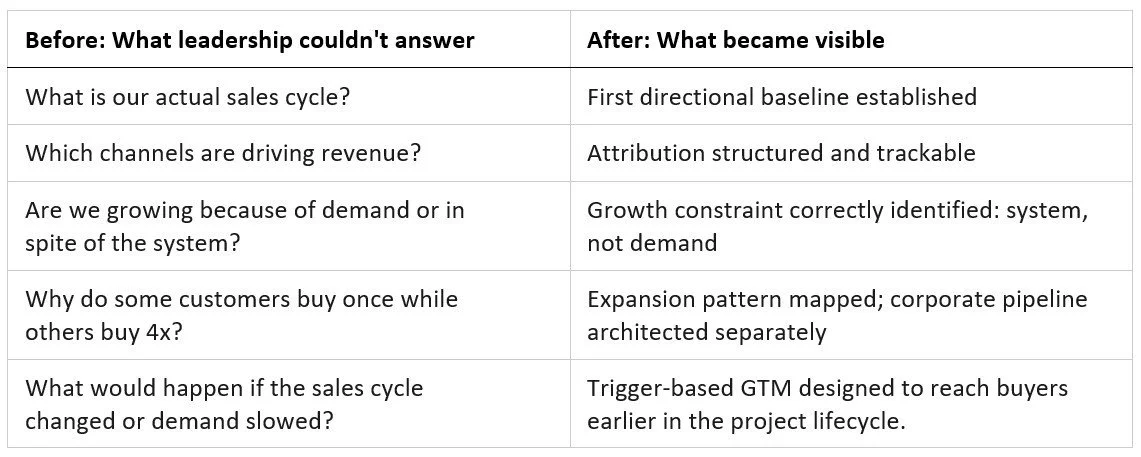
Sales cycle baseline established. For the first time, the business had a directional understanding of how long its actual sales cycle was and not an assumption borrowed from SaaS benchmarks, but a number grounded in its own data. That baseline changes everything: forecasting, rep accountability, lead nurture timing, board reporting.
Trigger-based GTM to remove project dependency. The adoption friction audit mapped exactly where in the project lifecycle decisions were being made and where the company was arriving too late to influence them. A trigger-based GTM system was designed to reach buyers earlier, with the right message, before manual workflows were already locked in.
Pricing reframed from features to risk. Pricing had been positioned around feature tiers, which drove buyers to compare costs and default to the lowest option. Reframing it around project risk and operational control, “what level of control do you need?” rather than “what features do you want?”, was projected to shift tier selection 20–30% toward mid-tier without changing a single price.
You’ve Seen This Before. You Just Didn’t Recognize It.
In 90 days, the business went from operating on partial truth to knowing exactly where growth was breaking and where to invest to fix it. Here's why that matters if you're running a building products company.
If you run a building products company and any of the following is true, your CRM is probably lying to you too:
You have strong spec-win rates or line review conversion but growth feels harder than the numbers suggest it should be.
You can’t reliably answer which marketing investments are driving pull-through vs. which are generating activity with no downstream revenue.
New dealer acquisition and existing dealer expansion run through the same pipeline, measured by the same metrics, managed by the same reps.
You have approved vendor status at accounts that should be buying more and you don’t fully understand why they aren’t.
Your best rep’s departure would expose a gap in conversion that no process currently covers.
A 90% close rate with flat or unpredictable growth is not a demand problem. It is a system visibility problem. Every dollar you spend on marketing before fixing the system accelerates the leakage.
The pattern I see repeatedly: manufacturers invest in brand, content, and campaigns to generate more top-of-funnel demand while the system beneath it remains invisible.
The $2.1M company in this case study is targeting $3M+ in 2026, roughly 50% growth. That target is achievable not because we’re adding demand, but because we’ve made the existing demand diagnosable. We know what’s working. We know where it breaks. We know which 57 customers to call this quarter and exactly what to say to them.
That’s the difference between a growth plan and a hope plan.
Your Pipeline Diagnostic
Before your next marketing investment, your pipeline system should be able to answer these four questions reliably:
What is your actual sales cycle, measured from your own data, not borrowed from an industry benchmark?
Which demand sources are generating revenue (not just leads), and what’s the cost per closed deal by source?
Are new account acquisition and existing account expansion running through separate pipelines with separate metrics or are they blended into a number that makes both invisible?
Which of your current customers should be buying more and what is the specific trigger that moves them to the next level of engagement?
THE HONEST TEST: If your CRM can’t answer all four of those questions from current data, you don’t have a pipeline system. You have a contact database and a wishful forecast. The work of growth starts with making the system tell the truth and not with adding more volume to a system that can’t see itself.From “How Do We Grow?” to “Where Is Growth Breaking?”
The 90-day audit and rebuild described here did not immediately increase revenue. That’s worth saying plainly, because most growth conversations are built around the promise of a fast result.
What it did was make revenue understandable and therefore scalable. It established the first reliable sales cycle baseline the business had ever had. It separated the expansion pipeline from the acquisition pipeline so each could be managed with the right focus. It identified the highest-value accounts to pursue this quarter, with the right message, at the right moment in their project cycle.
And it reframed the core question the CEO was asking. He came in asking: “How do we grow faster?” He left asking: “Where exactly is growth breaking and what’s the specific fix?”
Those are not the same question. The second one has an answer.
The system is already telling you where growth is breaking. The only question is whether you're listening to it or spending more to drown it out.
Client details have been anonymized. The work described was completed over a 90-day engagement in Q1 2026 by DHX Consulting.
If you’re a CEO or revenue leader in building products, AEC or consumer durables and want practical growth systems — subscribe. I publish weekly.
If you’re ready to diagnose what’s happening inside your own revenue system, Let’s talk.
Denine Harper, Founder & Fractional CMO, DHx Consulting. my services →