

Your bi-weekly block of insights, strategies, and innovative thinking for driving growth
Building Blocks

TAM Growth and the Art of Reshaping Demand
Most building products brands focus on winning more of the market they can already see. TAM growth is a different play entirely: redefining use cases, influencing specs, and introducing new buyers into the decision so the market itself gets larger. This article closes out the Rethinking Market Share series with a look at how companies like CertainTeed have turned repositioning into durable category leadership.

What Got You Here Won’t Get You There. How to Expand Without Unraveling.
Market expansion has the highest revenue ceiling of the four growth paths, and the most ways to go wrong. Entering a new geography, segment, or channel only works when the operational, marketing, and sales engines are ready to support it. This article breaks down how to sequence expansion deliberately, validate demand before sales arrives, and avoid the mistakes that turn ambitious growth plans into margin drags.

How to Win More Often When You’re Already on the Bid List
If your spec-in rates are strong but your close rates are weak, the problem isn't reach. It's conversion. Market share shift is about winning more often in competitive situations you're already in, and most companies lose not because their product is worse, but because their differentiation isn't clear enough to be remembered at the moment of choice. This article breaks down the four marketing moves that turn positioning into a real competitive advantage in the field.

The Overlooked Growth Path that Often Drives the Fastest Results
When building products manufacturers talk about growth, the conversation usually jumps to new markets, new products, and new channels. But in many cases, the fastest path doesn't require new anything. This article breaks down market penetration, the most overlooked of the four growth levers, and the five marketing plays that unlock trapped demand inside the customer base you already have.

Rethinking Market Share: A Smarter Framework for Building Products Growth
Most manufacturers say they want to “grow market share,” but the real question is which kind? This article breaks down the four distinct growth paths behind that goal (penetration, share shift, expansion, and TAM growth) and shows how each one requires different strategies, teams, and investment. With examples from Simpson, LP, Trex, and Andersen, it gives leaders a practical framework to turn vague share ambitions into focused, coordinated execution.

Seal the Leaks to Accelerate Growth by Turning Awareness into Profitable Demand
Too many brands buy awareness they never convert. This article breaks down why CAC is the real scoreboard, how spec-in and pull-through rates quietly determine profitability, and the fixes that turn impressions into booked revenue. From BIM libraries and CEUs to dealer pull-through and friction-free quoting, you’ll learn how to seal funnel leaks so every dollar of awareness compounds instead of evaporates.

9 Moves to Keep Your Margin, and Your Sanity, When Demand Won’t Sit Still
Demand keeps whiplashing, rates won’t sit still, and distributor power is reshaping the channel. This article breaks down the nine highest-impact moves building-products CEOs need to make before Q1 2026—from dual-curve forecasting and index-linked pricing to capacity shifts, spec-lock marketing, and volatility dashboards—so you can protect margin, stay in spec, and pivot fast when conditions change.
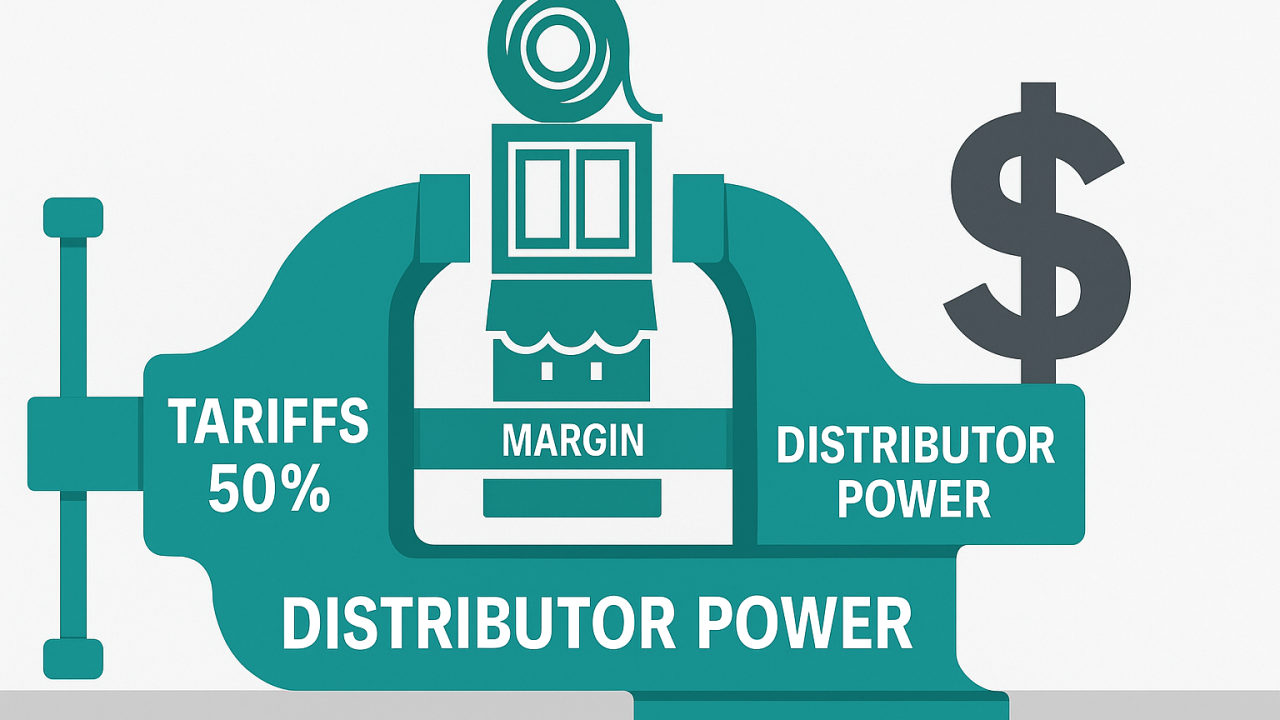
The Cost‑Price Vise: How Tariffs & Consolidation Are Crunching Margins
Tariffs are jumping, distributors are consolidating, and margins are getting crushed. This article shows how cost spikes hit your P&L, why pricing delays create leakage, and the moves manufacturers must make now—index-linked pricing, channel diversification, and spec-lock strategies—to protect profitability heading into Q4.

Your Dealer Is Not Your Frenemy: A Framework for Channel-Proof E-commerce
Struggling to grow online sales without alienating your dealers? This post breaks down DHx Consulting’s 5-step “Channel-Proof” framework, showing how manufacturers can boost e-commerce revenue, protect margins, and actually strengthen dealer loyalty. KPIs, quick wins, and real-world examples included.

Lost Labor, Won Specs: How to Turn the Job-Site Shortage into Your Competitive Moat
Labor shortages aren’t just a hiring headache, they’re bleeding specs, shelf space, and revenue. In this play-by-play guide, Fractional CMO Denine Harper shows CEOs of building products, consumer durables, and home goods brands how to time installs in minutes, translate every saved minute into margin, and rebrand “hidden-hero” SKUs that win faster, leaner jobsites.

Something Big Just Shifted in Building Products. Channel is Being Rebuilt in Real Time
There’s a seismic shift in the building products channel, from QXO’s acquisitions to Lowe’s Marketplace and changing contractor behavior, and what they mean for manufacturers facing tighter margins and rising platform dominance.

How PGT’s Return-Ready Rebrand Turned Storm-only Talk Into a 40% Sales Lift
Discover how PGT Custom Windows & Doors flipped its “storm-only” reputation into an everyday value story, unleashing a 40% sales surge in just 90 days. Learn the proof-first messaging tactics, content pillars, and KPI dashboard you can steal to turn hidden operational wins into board-level ROI.

How One KPI Turned a $180M Manufacturer Into a Margin Machine
89 days. That’s all it took for a $180M window maker to slash its quote time from 25 to 13 days, recover 140 bps of margin, and walk into the boardroom with an 88% forecast-accuracy slide every director wanted to screenshot. No extra headcount, no seven-figure software, just a relentless sprint we call the 90-Day GTM Accelerator™.

How to Get 40% More Visibility for the Same Budget
Discover how brands like HomeGoods and Wayfair leveraged downturns to increase visibility and market share without increasing budgets.

The Empty Stage Effect, Why Going Quiet in a Downturn Quietly Kills Your Valuation
Why cutting marketing in a downturn may feel smart but actually costs you future market share and long-term valuation. Learn how mid-market and PE-backed brands can gain dominance while others retreat.

The Economy Is Soft. But This Market Is About to Surge.
Home equity is at record highs. New home construction can’t keep up. And 60% of U.S. homes are over 40 years old. This article breaks down why we’re entering a multi-year renovation surge and why most mid-market product brands are wildly unprepared. If your marketing isn't aligned to contractor demand and homeowner renovation cycles, you're about to miss the biggest growth wave in a generation. Learn what to fix now to win share while others stall.

The One Piece Most Brands Overlook. Hint – It’s Not Marketing
The GTM Fix That Unlocked Dealer Growth. This case study unpacks how a mid-market manufacturer rebuilt its go-to-market system to fix flat growth and low dealer loyalty without a rebrand or new campaign.

Are You Building a Revenue Machine, or Just Burning Cash?
Stop Guessing. Start Driving Revenue. Most brands aren’t losing money because of bad marketing. They’re losing because of broken revenue systems hiding in plain sight. This guide shows you how to diagnose the real problem before it tanks your growth. Find out exactly where your marketing is bleeding revenue—and how to fix it fast.

Your GTM Strategy Isn't Broken. It's Costing You Millions.
Your marketing spend isn't moving the revenue needle because you're paying a hidden cost: The Misalignment Tax. Your sales team rewrites messaging, your channel partners can't articulate your value, and your marketing celebrates metrics while sales flatline. The result? Millions in unrealized revenue. The fix isn't another campaign. It's rebuilding your GTM engine from the ground up.

The Power of Story: Crafting Company Narratives CEOs Champion
In an industry often seen as commoditized, your story can be your sharpest competitive edge. Discover how the best companies build purpose-driven narratives that align teams, attract talent, and influence decision-makers across the value chain. Because specs don’t sell. Stories do.